Every hafiz needs someone to recite to. Most adults do not have one. I am that person — thirty minutes a day, in English or Urdu, with the mushaf open.
You memorised it as a boy. Someone listened to you every day, and because someone listened, it stayed.
Then school ended, or you moved, or you started working — and the listening stopped. Not the intention. Just the listening. Juz thirty is still there. Baqarah is mostly there. Somewhere in the middle it has gone quiet, and you have not looked directly at how quiet because there has never been a good moment to find out.
That is not weakness and it is not a failure of taqwa. Hifz is not a thing you have; it is a thing you keep doing. It decays without a listener the way a language decays without anyone to speak it to. The men who kept theirs are not more sincere than you. They had someone sitting across from them.
My name is Qazi Emaduddin. I studied in a madrasah, I read and follow Arabic closely, and when I could not find software that recorded a recitation the way it actually happens, I built it — the app the rest of this site is about.
I am still a student of the Quran myself. I have not completed hifz, and I am not going to sit above you and correct you. That is not modesty — it is the job description. Dhor was never about being taught. It is about being heard, and the men who kept their hifz kept it because somebody was on the other side of the mushaf every day, paying attention.
That is the work I do, and I do it carefully. I follow every word without drifting. I catch the word you softened and the ayah you slid past, and I mark it where it happened rather than telling you it was a good session. I keep the record, so that in six months there is something to look at instead of an impression. And I am there tomorrow, and the day after, at the same minute.
Some of the teachers using my software are far more qualified than I am — and if what you want is tajweed instruction or an ijazah, you want a qari, and I will tell you so. What I offer is a different thing, and for dhor the more useful one: attention that does not lapse, and a memory that does not either.
I listen in English or Urdu, to adult men — huffaz maintaining what they hold, and part-huffaz rebuilding what has slipped.
A video call. No app for you to install, no homework, nothing to fill in. You open the Quran and recite.
One session tells you little. A term of them tells you everything — which pages are holding, which words keep coming back months apart, and whether the ground you are regaining is staying regained.
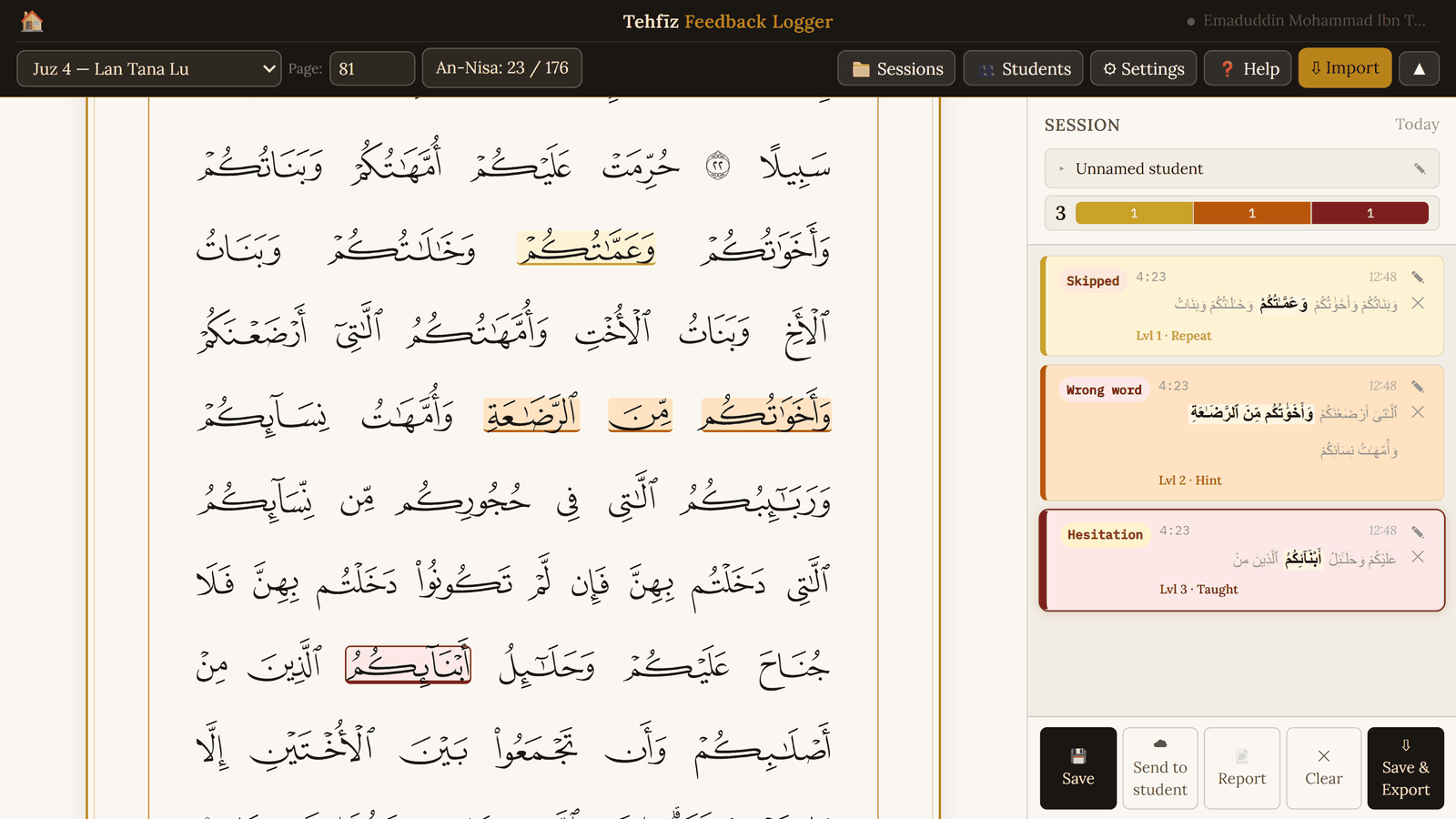
An actual session. The six-month picture is built out of these, one day at a time.
Standing in front of a jamaat is not the place to discover which pages are thin. From October, five sessions a week, half a juz at a time, gets you through the whole Quran with time to spare — and more usefully, gets you a written list of exactly which pages are still weak, while there is still room to do something about it.
Start in October and it is comfortable. Start in December and it is a sprint. There is no version that starts in January.
These are the slots I keep, shown in your own time — not mine. All of them fall inside my working day, which means you get someone alert rather than someone finishing a night shift.
| Where you are | Usual slot | Note |
|---|---|---|
| United Kingdom & Ireland | 05:30 – 07:00 | After fajr, before work |
| US East & Toronto | 05:30 – 07:00 | After fajr |
| US Central | 05:30 – 07:00 | After fajr |
| US West | 06:00 – 07:30 | After fajr |
| Sydney & Melbourne | 20:30 – 22:00 | Evening, after isha |
| Gulf | 05:00 – 06:30 | After fajr |
Fajr moves through the year, and so does the slot — we shift it together rather than you holding a fixed clock time that stops making sense in June.
Billed monthly, for five 30-minute sessions a week. No joining fee, no contract, no notice period — tell me you are stopping and you stop.
Thirty minutes, free, no commitment afterwards. You recite pages picked at random from across whatever you hold. I mark everything. Then I send you the report and you decide what to do with it — including nothing.
Most men have a rough idea of where they stand and it is usually wrong in both directions — worse in the middle juz than they feared, better in places they had written off. It is worth thirty minutes to stop guessing.
Or write to contact@tehfiz.com. I answer these myself. Four slots a week, so it may be next week rather than this one.